You have questions. We have the fixes
Understanding our SOTA performance on benchmarks like SWE-Bench and SWT-Bench.
Understanding our SOTA performance on benchmarks like SWE-Bench and SWT-Bench.
LogicStar identifies what matters in your system.
It prioritizes the bugs that impact customers and revenue, investigates them fully, and delivers validated fixes as ready-to-merge pull requests.
Within the first hour, LogicStar shows a small set of prioritized bugs, typically the top 5, ranked by customer impact and ARR at risk.
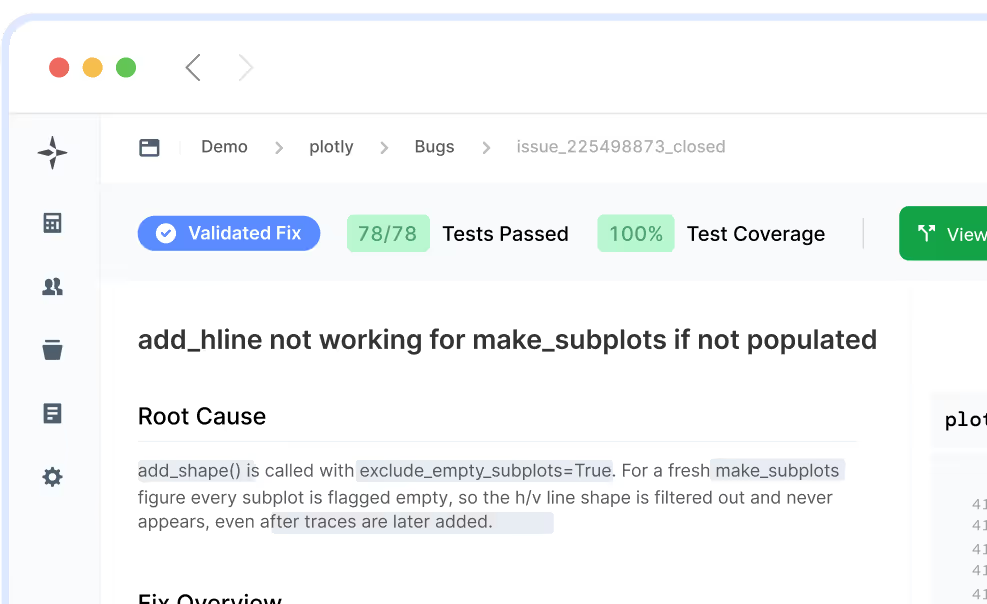
Each includes root cause, affected users, and a validated fix proposal.
LogicStar produces a clear priority of what to fix next, based on business impact rather than severity.
It combines production signals, customer reports, and code analysis to determine:
how many users are affectedhow critical the feature ishow often the issue occursThis ensures your team focuses on the bugs that matter most.
Observability tools show what is happening in your system.
LogicStar identifies why it is happening, traces issues to their root cause in the code, and proposes validated fixes.
It turns signals into actionable engineering work.
LogicStar adds a priority layer on top of these signals.
Copilot, ChatGPT, and Claude Code help developers write and modify code based on prompts.
LogicStar works at the system level. It analyzes production signals, your full codebase, and real usage to identify what actually matters and prioritize the bugs impacting customers and revenue.
Instead of relying on prompt-time context, LogicStar uses a structured, system-wide process to investigate issues, trace them to their root cause, and propose validated fixes.
LogicStar provides a structured handoff, enabling these tools to implement fixes with full context, without repeated prompting or guesswork.
No. PR review tools analyze code changes in isolation and help enforce code quality and conventions by focusing on individual code changes.
LogicStar operates at the system level. It uses production signals and full application context to identify what actually needs to be fixed and traces issues back to their root cause.
In practice, LogicStar ensures your team works on the highest-impact problems first, while PR review tools ensure the fixes are implemented correctly.
LogicStar correlates signals across your systems to identify which issues matter and are worth fixing.
By combining these signals with code analysis, it identifies which issues are real, reproducible, and worth fixing.
LogicStar only proposes fixes it can validate.
Each issue is reproduced with tests, and every fix must pass those tests along with relevant existing tests. If the system cannot confirm the fix, it does not create a pull request.
Only validated fixes for prioritized issues are proposed.
No. Every proposed change is delivered as a pull request.
Your team reviews and decides whether to merge, maintaining full control over the codebase.
LogicStar focuses on backend and system-level issues such as:
logical errorsAPI misusemissing validationsinconsistent state handlingmany classes of security vulnerabilitiesIt is most effective on issues that can be reproduced and validated.
LogicStar is less suited for:
visual or UI-related issuesfront-end rendering problemscertain distributed system edge cases that are difficult to reproduce deterministicallyThese typically require human interaction or external context.
LogicStar connects to your existing tools, including:
GitHub or GitLabobservability platforms like Sentry or Datadogissue trackers such as Jira or LinearIt delivers results as standard pull requests, so your team can work within familiar workflows.
Setup typically takes a few minutes, and most teams start seeing high-impact issues within hours.
No new instrumentation or major changes to your codebase are required.
LogicStar works with your existing test suite.
Higher coverage increases the range of issues that can be validated, but LogicStar can also generate additional tests when needed to reproduce and verify issues.
If LogicStar cannot confidently reproduce or validate an issue, it abstains.
Your team only receives fixes that are backed by evidence and passing tests.
LogicStar removes most of the time spent deciding what to fix, triaging issues, and investigating root causes.
Teams can focus directly on reviewing and merging fixes instead of investigating issues.

LogicStar benchmarks software engineering agents on your code, finds their blind spots, and measures whether changes to models, prompts and tools improve the result. Keep measuring as the agents and code change.