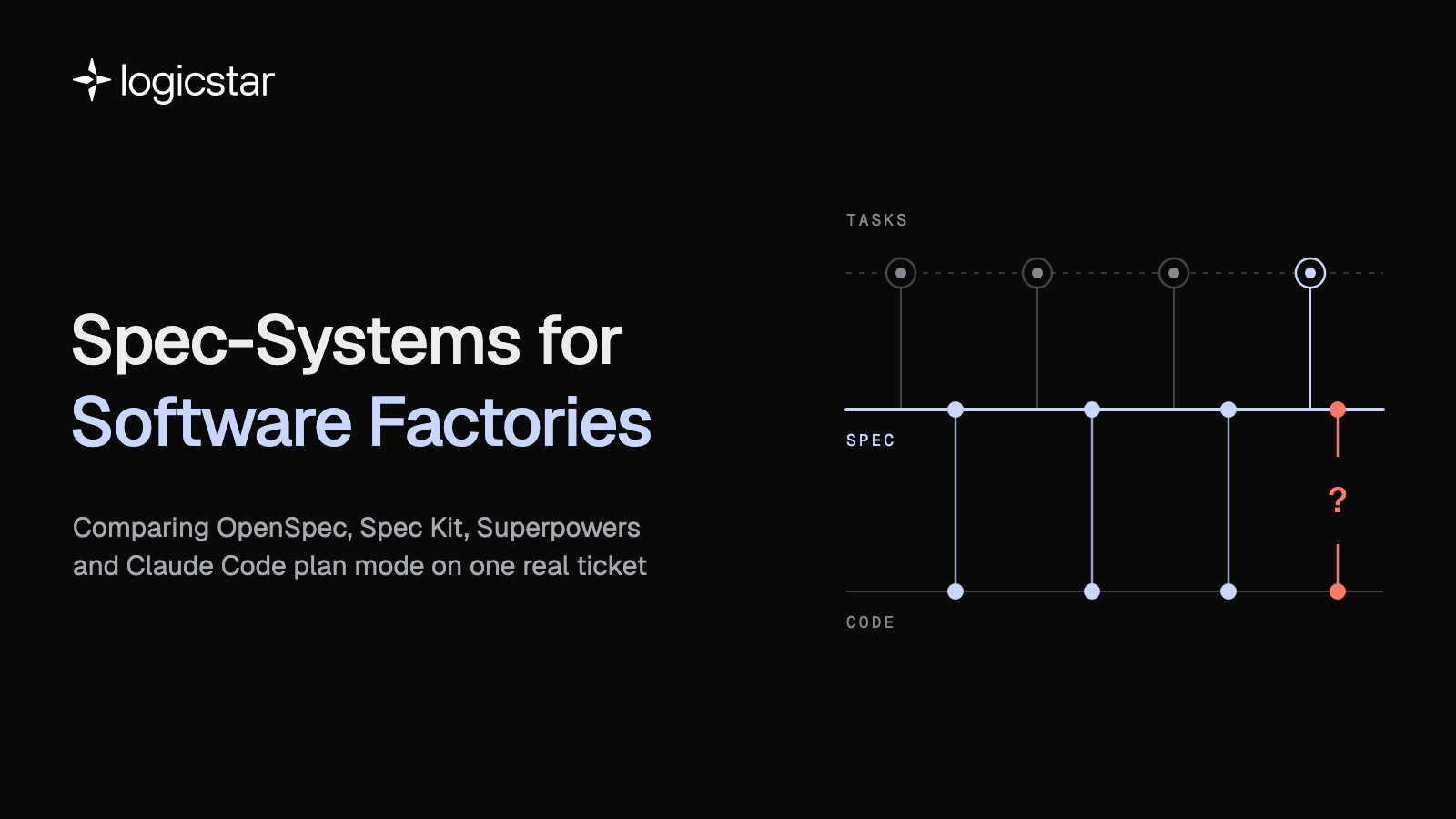
Spec Systems Change What's Left Behind More Than the Code
Each task starts without the requirements. The spec keeps them.
Living specDrift checkCode
Writes the requirements.
What a spec system has to do
Define the goal. Starting with a short ticket, we need to define what "done" means with increasingly more precision. This way, edge cases and undefined behaviour are surfaced before they invalidate an implemented architecture.
Keep current behaviour cheap to read. Reading a full codebase to understand what it is supposed to do is not only slow and expensive (even for LLMs) but also does not separate intent from coincidence.
Surface contradictions early. When a new request contradicts an earlier decision, this has to be highlighted and the contradiction resolved as early and efficiently as possible.
Detect drift between code and spec. When the two diverge, the code is buggy or the spec misleading. These cases must be found and remediated.
Higher quality, better tested code follows.
The four systems
We tested OpenSpec 1.16.0, GitHub's Spec Kit 1.3.0 and the Superpowers 7.0.2 plugin against plan mode in Claude Code 2.1.317 as the baseline.
Plan mode. The agent plans read-only, a person approves, and it builds. The plan stays outside the repo, so we added a one-line rule that keeps a short spec in specs/.
Superpowers. The agent brainstorms with you, writes a design and a plan, then builds with fresh subagents reviewing the work. It leaves dated design and plan files.
OpenSpec.propose writes a proposal, a design, tasks and spec deltas, and apply builds them. archive merges the deltas into living specs and moves the rest to an archive.
Spec Kit. Separate commands write a spec, then a plan with research, a data model and contracts, then tasks. implement builds them, and converge checks the code against the spec and adds tasks for any gap. Each feature keeps its folder.
The steps, and what they produce
A person reviews hereOptional
Final specArchivedNot in repo
How we tested
Each system was tested against the same series of tasks: a full feature (ingesting historically faithful PR review comments into our data platform, a change that took us +1,444/−69 lines), a small follow-up feature, a bug fix, and 5 drift and contradiction scenarios.
To keep instructions consistent, a Claude session played the engineer from a fixed answer sheet, in addition to running the feature through OpenSpec and Spec Kit by hand. We scored each build against 16 gotchas we found while implementing and reviewing the real change ourselves. We counted only the gotchas that could occur in a build's design and let our full CI and code review run on every build of the full feature.
What each test does to spec and code
SpecCodeOld ruleNew request
AgreeDisagree
Spec and code written together, from one real ticket.
Results
Implementing one feature: similar code, different cost
One ticket, six builds: similar code, plan mode at about half the cost
Plan mode$11.08
Superpowers$19.30
OpenSpec$20.05
Spec Kit$26.41
OpenSpec by hand$20.91
Spec Kit by hand$22.72
Plan mode built the ticket for $11.08, against $19.30–26.41 for the others, at API rates. All six builds kept every constraint the ticket set and passed CI. Beyond that, one ticket doesn't separate them: all missed 3 to 6 gotchas and received 1 to 7 review findings. The two Spec Kit builds had both the fewest findings and the only P0. What did change the code was review inside the workflow. Superpowers' reviewer and Spec Kit's converge caught a real defect each. A spec system thus mostly improves code through the review it enables, not through the spec itself.
Review: skimmability matters
What you get from reading only the headings
States a rule or names a caseNames a section
To review specs, chat is great for co-development. In a factory, however, review happens asynchronously, and for that a document is a much better choice. Reading every word the spec systems produce (up to 16,000 for our feature) isn't realistic. What works better is skimming the requirements, decisions and risks, then digging deeper where something looks off or is particularly tricky. For that, a good structure and skimmable headings matter. Here OpenSpec excels with descriptive titles, while Spec Kit and Superpowers mostly number and name sections, with one useful exception in Superpowers: "Calls made by Claude (check these)".
The spec that is left behind
What each system leaves in the repo, in words
SpecOther docs, in placeOther docs, archived
Plan mode681
Superpowers2,754 of 7,099
OpenSpec1,805 of 7,562
Spec Kit3,611 of 16,015
In a software factory, an agent working on a new task doesn't inherently know which requirements the system already has to meet. That is a key role of the spec, and more precisely of the permanent record it leaves behind when a task is done. That works best as a short statement of how the system is supposed to behave now, not a history of how it got there. Only OpenSpec builds this split in: each change merges into living specs, and the details of how we got there are archived. After a ticket is done, a later change only has to read a 1,805-word spec instead of all 7,562 words written along the way. Spec Kit keeps a folder per feature, 16,015 words for ours. Plan mode's spec is the shortest, at 681 words, but also captures the fewest of the gotchas to look out for, 3 of 16 against 6–10 elsewhere.
The planted bug shows the spec at work. All four restored the guard, but only OpenSpec asked whether the report meant a bug or new behaviour, because its spec and the latest commit disagreed. Superpowers fixed it fastest without opening its spec at all.
How spec-contradicting tickets are handled
After implementing the feature, we tested whether the spec system notices contradictions with three requests that each reverse an earlier rule: use poll time as push time, let analysis fetch from GitHub, and backfill from project exports.
First reaction to a request reversing a rule
Stopped and askedFlagged, carried onNever noticed
Poll timeGitHub fetchExports
Plan mode9 of 9
Superpowers8 of 9
OpenSpec8 of 9
Spec Kit3 of 9
Of 36 runs, 28 stopped and asked, 7 flagged the conflict and carried on, and 1 never noticed. 26 cited hand-written repo docs. Plan mode stopped in 9 of 9 by finding each rule in a written document: its own short spec, a design-decision doc or an older spec. What catches a contradiction is a decision written down where the agent looks, whichever tool wrote it. OpenSpec's one miss shows the other side: the rule sat in an older spec not in OpenSpec's format, and its search output was cut off before reaching it. Spec Kit's 6 all noticed the conflict, but its specify step writes the spec before it can ask, so each had already rewritten or reversed the rule. Superpowers' one asked why we wanted the change but had already decided to replace the old rule.
How drift between spec and code is handled
On a throwaway branch, we made the code and the spec disagree in one of two ways: a commit that changed behaviour against the spec, or a new requirement in the spec with no code behind it. Each run then got the same messages in order: an unrelated one-line edit a few lines from the drift, the system's own check where it has one, a plain request to check whether code and specs still agree, and "resolve what you found".
Planted drift between spec and code: when each run found it
Found it, asked for decisionFound it, decided itselfNot found
UnpromptedOwn commandOnce asked
Plan modeNo command
SuperpowersNo command
OpenSpec
Spec Kit
OpenSpec + our commandNot needed
No run noticed the drift while making the edit. Of the built-in checks, Spec Kit's converge found it in 6 of 6 runs. OpenSpec's verify checks only an active change, and with everything archived it had nothing to check. Asked plainly, all 24 runs found it.
Told to resolve it, plan mode asked us which side was right in every run, the others in about half. Left to decide, every run sided with the spec, whichever side had moved.
We wrote a 444-word command for OpenSpec, modelled on Spec Kit's converge. It is designed to always surface drift but never fix it: it compares the code with the living specs, names the commit that moved, says for each finding what a person has to decide, and stops. It found the drift in 6 of 6 runs, at about $1.25 for 18–19 requirements.
What to run in a factory
OpenSpec for the living spec. It is the only system that keeps a short statement of current behaviour apart from its history, and its descriptive headings make asynchronous review a skim instead of a read.
A scheduled drift check that only reports. No agent noticed drift during an ordinary edit. Drift needs to be surfaced regularly and triaged for how it should be resolved.
An independent review gate before merge. Review inside the workflow, based on the spec, is essential to catch real defects.
Iterate where it's cheap: first on the ticket, then on requirements and decisions for larger changes.
When a person drives each change and holds the context, plan mode plus an independent review is enough and much cheaper, at $38 for all tasks in the trial together against $57–73 for the others.
Limits
This is one codebase and one feature, and AI agents were used to score the runs together with our tests. We haven't yet compared these methods over a series of features where the spec really accumulated. We'll share more experiences on that in the future.
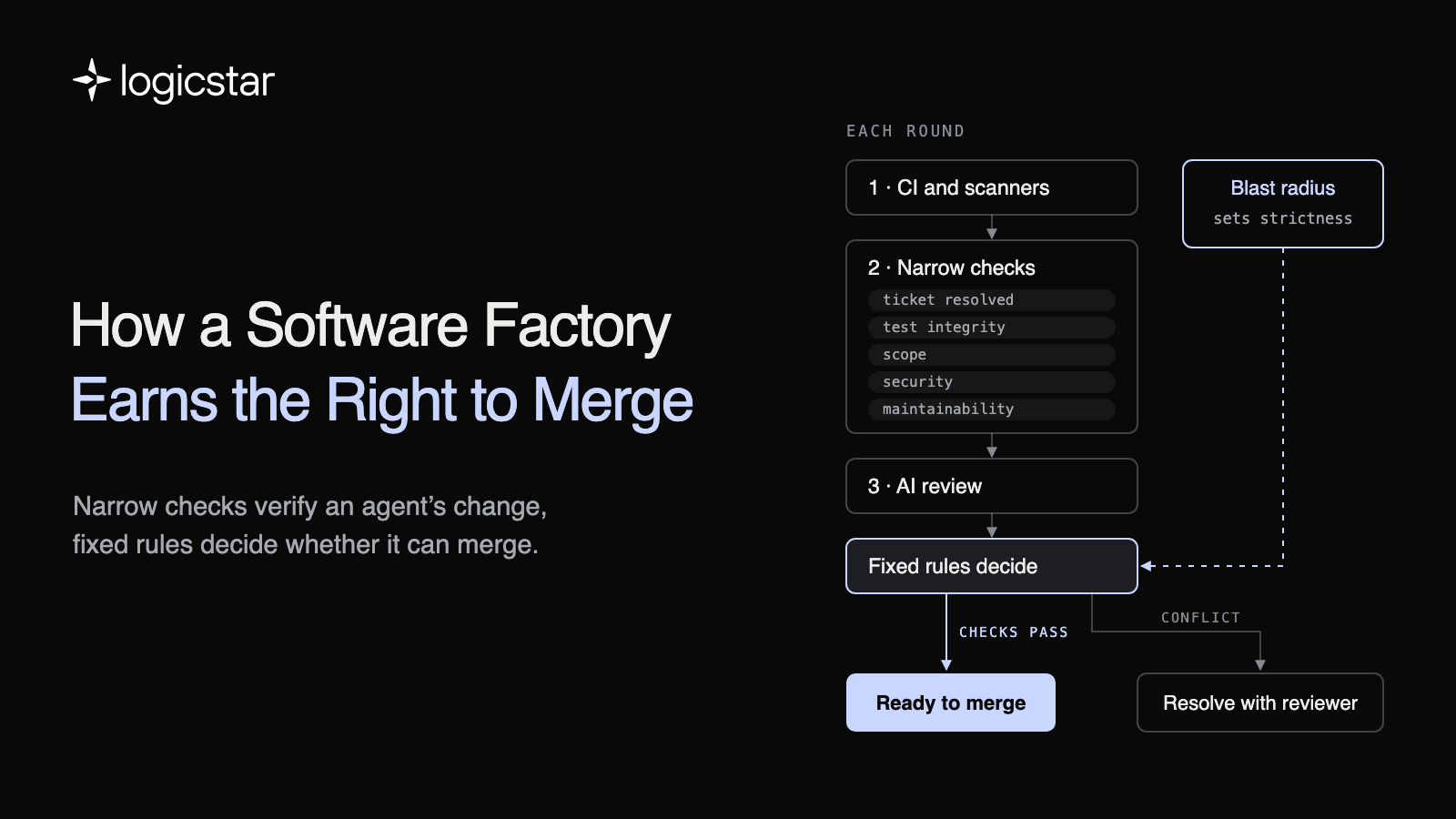
A coding agent can turn a ticket into a green pull request in minutes. We split the merge decision into narrow checks, let fixed rules decide, set the strictness by the blast radius of a change, and bring in a person only where the agent gets stuck.
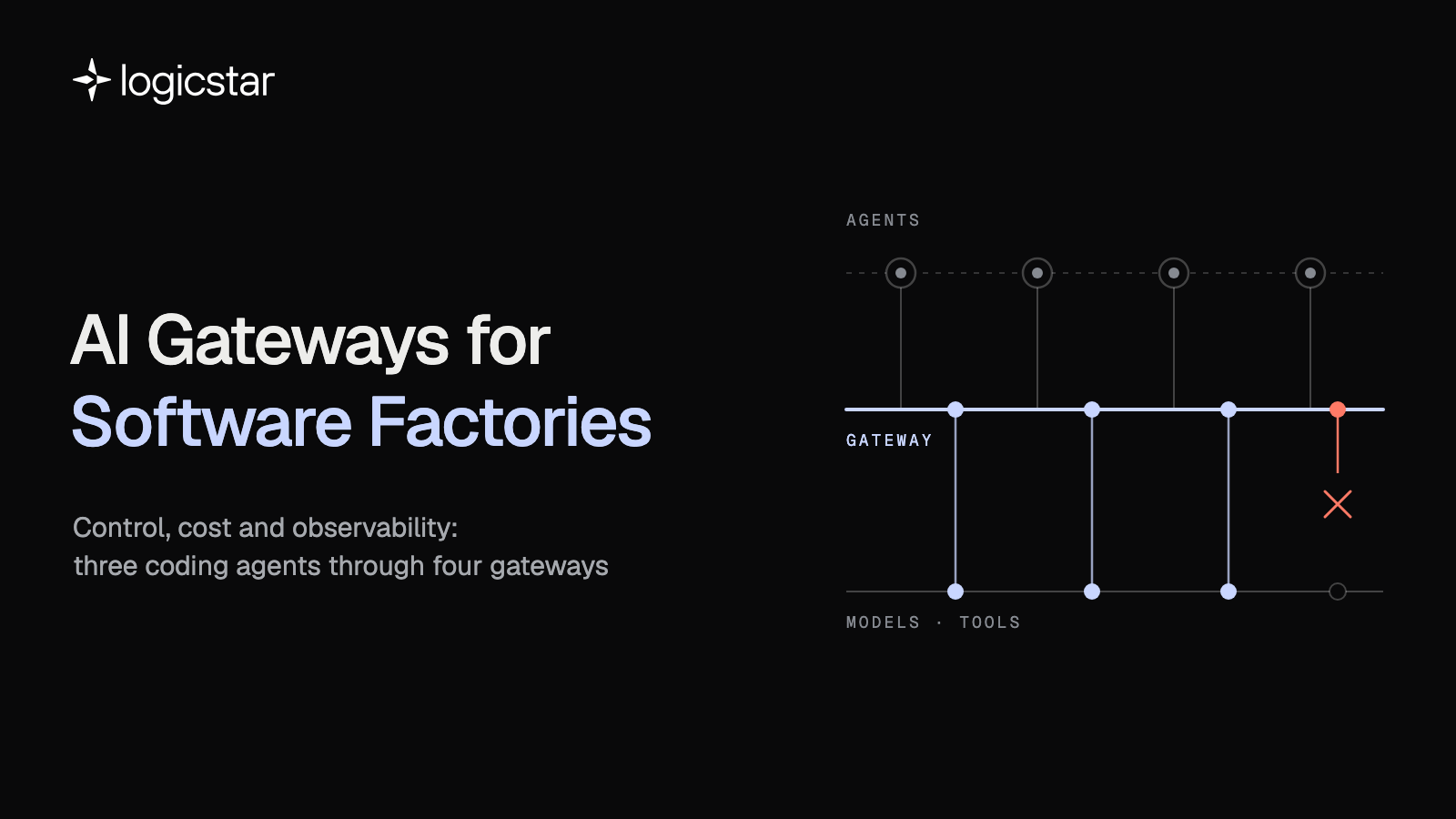
We ran three coding agents through four gateways to see what a gateway controls, what it measures correctly and where it misleads you, from budgets that overshoot to telemetry that leaks prompts and data residency set hop by hop.
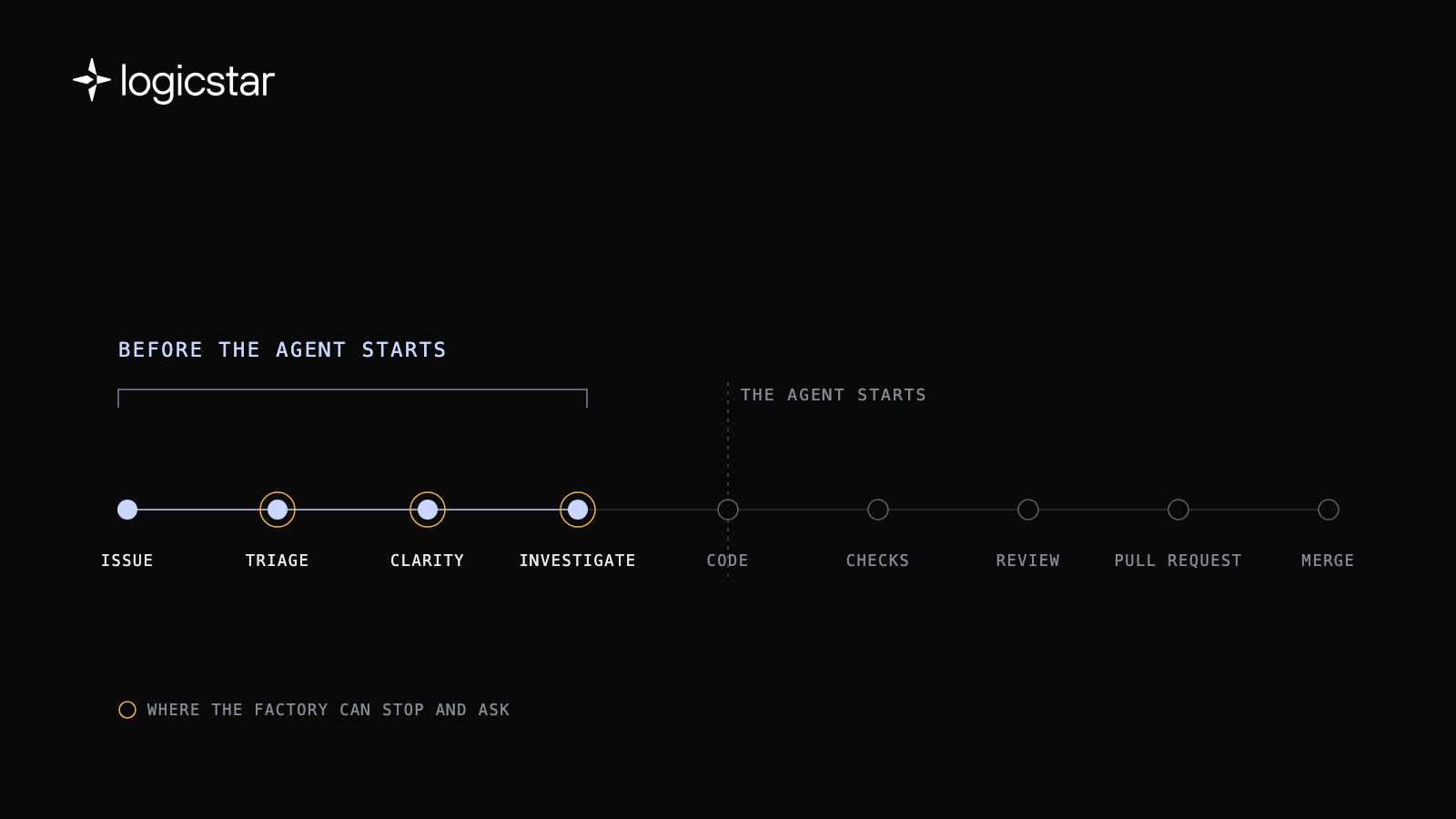
We compared a stronger model, a different agent, answers from the author and a read-only investigation before any code. On 19 fresh tickets, the investigation went ahead on 9 of 10 wanted changes and held back 7 of 9 requests an author had already declined.
We use cookies to run the site and understand how it’s used. You can accept all cookies or reject non-essential ones. See our Cookie Policy.
Cookie settings
By clicking 'Accept all cookies', you agree to storing cookies on your device to enhance site navigation, analyze site usage and assist in our marketing efforts as outlined in our cookie policy.